Iowans’ Electricity Bills Rise 65% in Twenty-Five Years
I know what it feels like to come home to a house with no electricity, no heat, or no air conditioning, and the subsequent scramble to figure it out that follows. No Iowa family should be at risk of the lights not turning on when the switch is flipped.
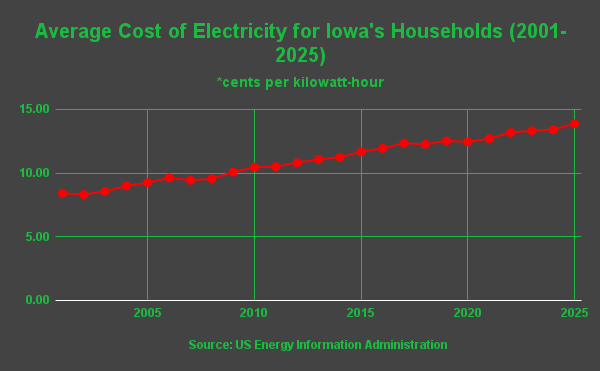
In 2001, Iowa families paid 65% less for electricity in their homes than they do today. At the same time, the rate of households that have had their power disconnected continues to rise. In 2001, Iowans paid just 8.41 cents per kilowatt-hour (kWh) for electricity, and by 2025, this cost had risen to 13.88 per kWh on average.
This increase translates to an average bill increase of at least $45/month, or $546/year, when using the 2024 average monthly household consumption of 832 kWh.
Link to source: https://www.eia.gov/states/ia/data/dashboard/custom
This increase is felt hardest by the most vulnerable in our communities, including low-income families across House District 33. Most areas of the district are considered to be low-income by the federal government, meaning they are in the top third in the country for households living at or below the federal poverty level of $15,650 annually for a single person or $32,150 annually for a family of four.
Furthermore, Black households are three times more likely to have their power shut off, due to the share of income they spend on electricity bills and the energy efficiency of their homes. Other Iowans, particularly seniors, count on reliable and affordable electricity to power their medical devices, like CPAP machines, oxygen delivery systems, and motorized wheelchairs.
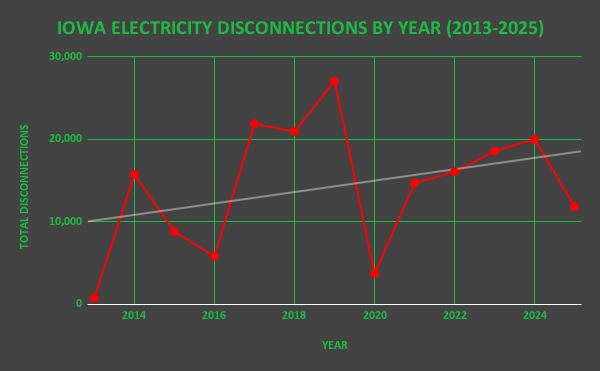
The evidence of the most vulnerable in our communities having their electricity turned off is clear in the number of service disconnections each year. While the number of disconnections varies on a yearly basis varies–falling to its lowest in 2020 when there was a nationwide moratorium on disconnections–the trend is clear; Iowans are having their electricity turned off at an increasing rate.
When families already have to make decisions between putting food on the table, seeing a doctor, or keeping the lights on, this gradual increase in electricity makes it harder to get by, let alone get ahead.
If elected to the Iowa Legislature, I will work to implement policy solutions that lower the cost of electricity for working families in House District 33 and across Iowa. The cheapest kilowatt of electricity is the one we never have to make, use, or pay for, so I will begin by rolling back the harmful changes made by utilities in 2018 through Senate File 2311.
By requiring more investments in better insulation, more efficient appliances, and upgraded windows and doors, we can help reduce the financial burden of higher utility bills for the families most vulnerable to having their power turned off. Furthermore, changing energy policies to empower the Iowa Utilities Commission to require long-term planning, increase transparency, and foster competition among utilities would put affordability and reliability at the top of the priority list in Iowa’s energy future.
Iowans deserve a state representative who understands these challenges and can work to propose bipartisan, lasting solutions that benefit working families in every corner of our state.
Final note: the exact average bill increased from $69.97 in 2001 to $115.48 in 2025 - an increase of at least $45/month.
